In Dante’s Inferno, the Fifth Circle of Hell represents the sin of Anger, split into two distinct, eternal punishments based on how the emotion was handled in life: the wrathful and the sullen. Located along the murky, putrid swamp of the River Styx, those who gave in to outward rage are condemned to fight each other endlessly. These souls, completely overcome with fury, tear, bite, and strike one another with hands, feet, and teeth, continuing their violent earthly behavior in a chaotic, unending battle.
Beneath the filth of this same marsh are the sullen, whose anger was repressed, bottled up, and turned inward during their lives. Unable to express their fury, they are submerged in the slime, gurgling in a permanent state of silent, inward rage. They are doomed to choke on their own stifled emotions, singing a miserable, garbled song that never reaches the surface. This dual punishment highlights Dante's belief that uncontrolled, volatile anger—whether expressed violently or festered secretly—is a disruptive force that ruins the self and others.
A pivotal, symbolic moment occurs in Canto VIII with the appearance of Filippo Argenti, a Florentine contemporary of Dante who was known for his extreme wrath. As Argenti attempts to capsize their boat in the Styx, the pilgrim Dante expresses an unusual, intense rage toward him, which the guide Virgil applauds. This interaction showcases a shift where Dante begins to understand that, unlike previous sins, anger must be met with "righteous indignation" rather than pity, illustrating a key step in his moral journey toward understanding divine justice.
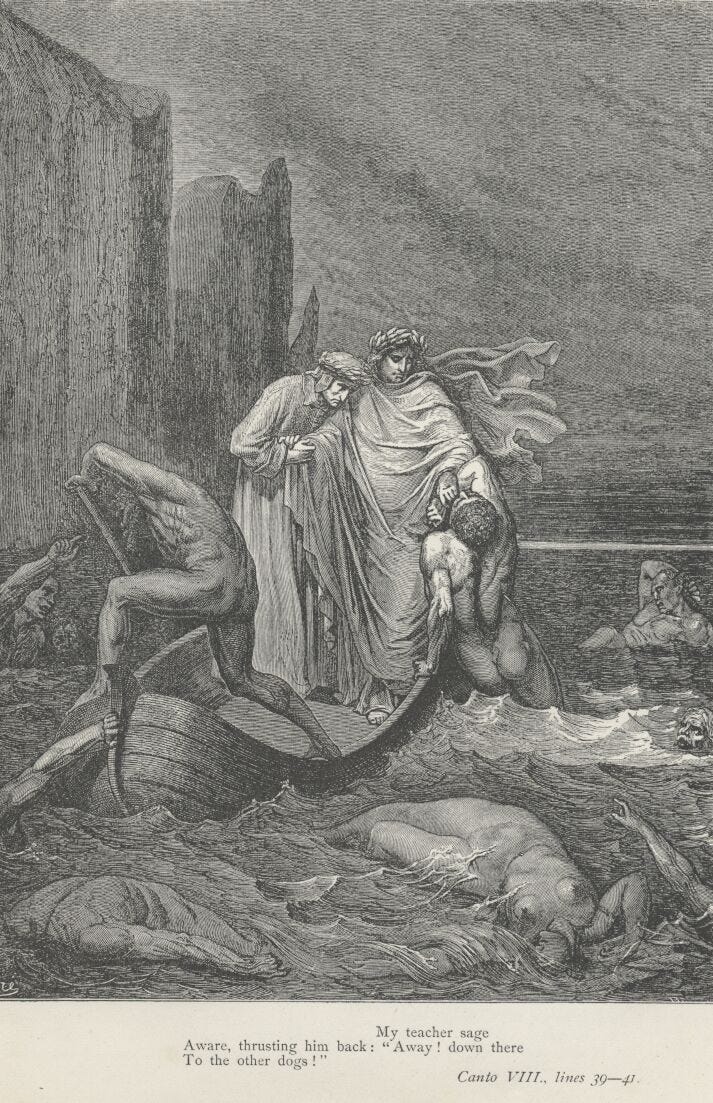
Filippo Argenti is a resident of the Fifth Circle of Hell in Dante’s Inferno, specifically located in the River Styx among the Wrathful and Sullen. Appearing in Canto VIII, he is depicted as a prominent, wealthy, and violent Florentine nobleman, belonging to the Adimari family—a Black Guelph faction that opposed Dante and was instrumental in the poet’s exile. Reputedly known for his excessive pride, such as shoeing his horse with silver, and for his "iron fists," Argenti serves as a symbol of the arrogance and corruption that destroyed Florence in Dante's eyes.
Dante’s encounter with Argenti is profoundly personal, marking a shift from the pity the poet previously showed to the damned in earlier, higher circles of Hell. While crossing the Styx in Phlegyas's boat, Argenti accosts Dante, leading to a hostile verbal exchange where Dante curses the "hell-dog" to remain in the mud. This interaction is one of the rare moments where the character Dante expresses intense, visceral hatred, wishing to see the sinner suffer further, a sentiment fully supported by his guide, Virgil.
The fate of Filippo Argenti is particularly brutal, fitting the nature of his sins. Upon being dismissed by Dante, Argenti is immediately attacked by his own companions—the other shades in the Stygian marsh who turn on him in a frenzy of violent, mutual fury. He is left being torn apart by them, a scene of poetic justice that delights Dante, as Argenti’s rage and selfishness in life are returned to him in death through the violence of his peers.