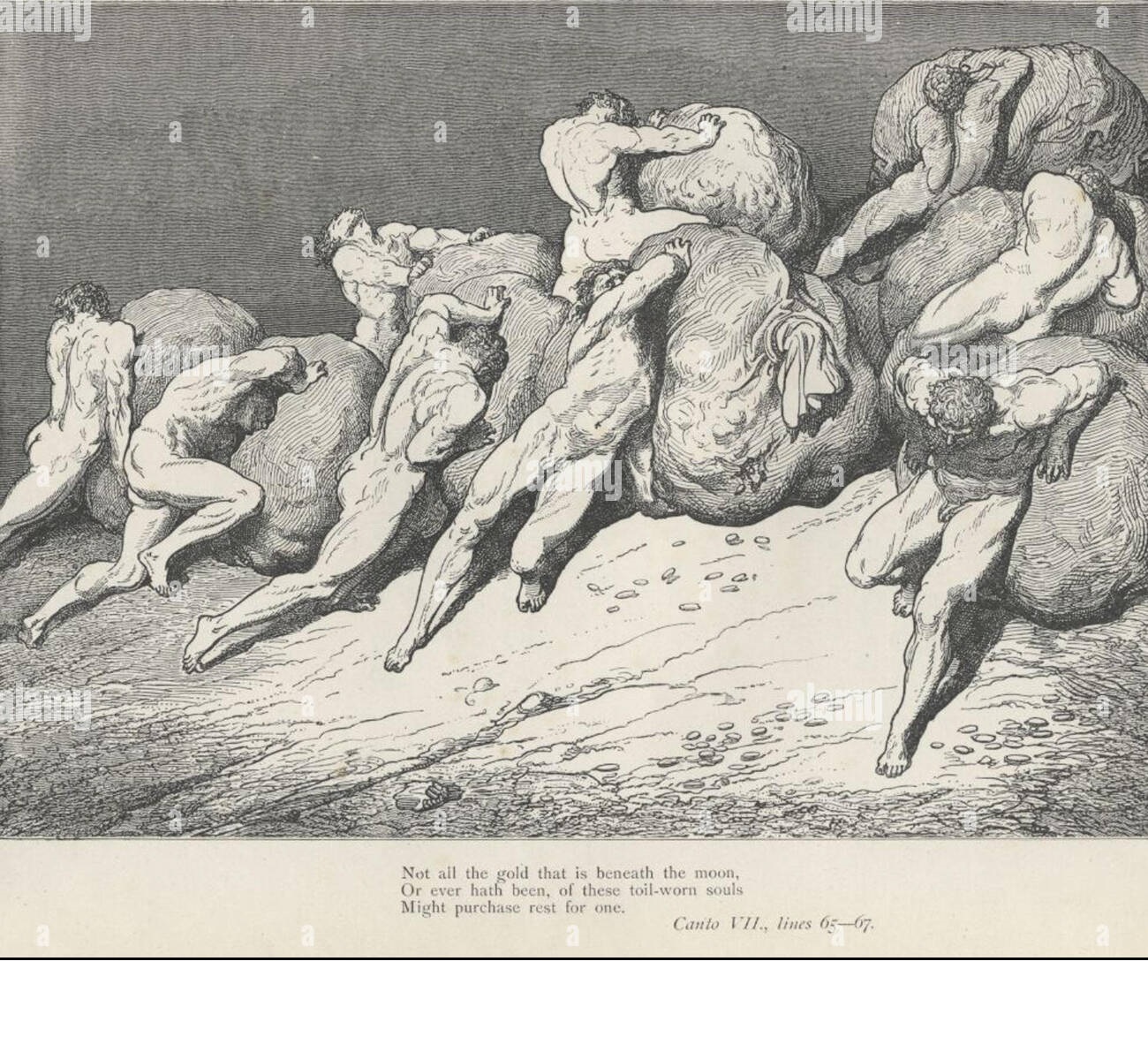
The Fourth Circle is dedicated to the sin of Greed, punishing both those who hoarded wealth (the avaricious) and those who squandered it (the prodigal). Guarded by the demon Plutus—who symbolizes wealth and incoherently shouts as he sees the sinners—this realm forces the damned into a futile, repetitive existence. The two groups, representing opposite abuses of material goods, are condemned to push massive, heavy weights (symbolizing the burdens of their worldly possessions) using their chests, clashing against each other in a never-ending, circular struggle.
The punishment in the Circle of Greed is designed as a contrappasso, where the nature of the sin determines the form of the punishment. Having wasted their lives focused entirely on gaining or wasting material wealth, these souls are stripped of their individuality and forced to labor in a mechanical, joyless "factory of torture". The chaotic clashing of the hoarders and wasters, who scream "Why do you hoard?" and "Why do you waste?" at each other, highlights the futility of their earthly obsessions. Many souls here are unrecognizable, their faces and identities degraded by the obsession with material goods that consumed their lives.
Within this circle, Dante also explores the concept of Fortuna (Fortune) as a divine minister. Virgil explains that the wealth these sinners fought over is governed by a higher, angelic intelligence that shifts fortunes, making human obsession with accumulating money foolish. The circle also features prominent figures and, according to Infernopedia, a representation of the "Accursed wolf," symbolizing avarice. The atmosphere is heavy, chaotic, and monotonous, perfectly reflecting the spiritual emptiness of a life driven only by greed.
Plutus
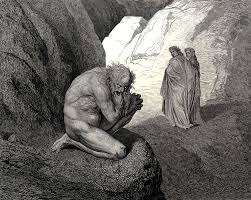
In Canto VII of Dante’s Inferno, Plutus appears as the demonic guardian of the fourth circle, which houses the hoarders and wasters (the avaricious and the prodigal). Formerly the Greek god of wealth, Plutus is transformed by Dante into a monstrous,, wolf-like figure who embodies the destructive nature of greed. As the poets approach, he greets them with a terrifying, incoherent roar—"Papé Satàn, papé Satàn aleppe"—a phrase often interpreted as a mixture of French, Hebrew, and Latin designed to invoke Satan and express shock at the presence of the living poets.
Plutus is depicted as a "cruel monster" or a "cursed wolf," symbols that highlight the predatory, grasping nature of inordinate desire for material possessions. His presence serves as a barrier, preventing Dante and Virgil from entering the deeper, more severe parts of hell until Virgil asserts divine authority. Virgil commands him to be silent, declaring that their journey is willed by God and that Plutus’s rage will only consume himself. Upon this, the monstrous figure falls to the ground, collapsing like a broken mast, demonstrating the ultimate impotence of sinful passion when confronted with divine order.
The placement of Plutus in the Fourth Circle is deeply symbolic, as he represents the spiritual sickness of hoarding and squandering wealth. He stands guard over those who allowed their, lives to be controlled by the whims of "Fortune," a concept Virgil explains in this canto as a divine minister. Furthermore, Plutus acts as a bridge between classical mythology and Christian demonology, functioning as a "watchdog" for the sins of incontinence that, according to Dante, corrupt humanity.