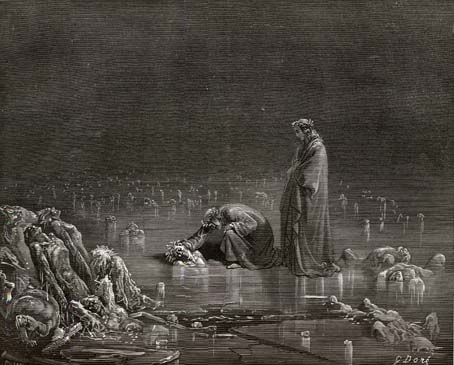
Treachery is depicted as the ultimate sin, situated in the Ninth and deepest Circle of Hell, symbolizing a complete violation of human love and trust. Unlike the sins of violence or lust, which may be driven by passionate impulses, treachery is a cold, calculated, and intellectual sin, which is why it is situated in a frozen lake known as Cocytus. This frozen landscape, solidified by the flapping wings of Lucifer, reflects the utter lack of warmth, love, and loyalty in the hearts of those who betrayed their kin, country, guests, or masters. Dante reserves this lowest point for those who abused the unique human capacity for trust and reason.
The Ninth Circle is divided into four zones named after famous betrayers: Caina (betrayers of kin), Antenora (betrayers of country), Ptolomea (betrayers of guests), and Judecca (betrayers of benefactors). In this realm, the sinners are trapped in ice, with their level of immersion corresponding to the severity of their betrayal, some buried completely while others are only up to their necks. This environment represents the total isolation and spiritual rigidity of the traitor, who, in life, cut themselves off from the human community through their deceitful actions.
At the very center of Hell, frozen waist-deep in the ice, sits Lucifer, the ultimate traitor who betrayed God. In his three mouths, he eternally chews on the three greatest betrayers in Dante's view: Judas Iscariot, who betrayed Jesus, and Brutus and Cassius, who betrayed Julius Caesar. The image of Judas having his head gnawed by Satan, while Brutus and Cassius are chewed feet first, reinforces the idea that betrayal of God and political order is the worst possible crime. This harrowing scene highlights that, for Dante, treachery is a profound, selfish act that disrupts the natural order, leaving the sinner to forever dwell in a state of absolute, icy darkness.