Violence is not simply an act of aggression, but a specialized, structured sin punished within the Seventh Circle, which is guarded by the Minotaur and divided into three distinct rings. Virgil explains that violence can be directed against three primary targets: one's neighbor, oneself, or God. This hierarchy of violence reflects a profound, nuanced view of sin, where the gravity of the offense dictates the severity of the contrapasso, or the ironic punishment, tailored to each sinner. The imagery is often graphic, utilizing blood, fire, and bodily dismemberment to illustrate the lasting damage inflicted by these transgressions on both the victims and the souls of the perpetrators.
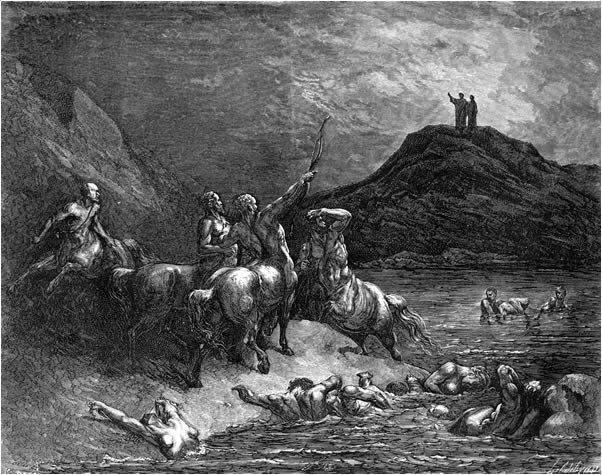
The first ring of the seventh circle deals with violence against neighbors, specifically targeting murderers, tyrants, and robbers who shed blood or stole from others. These souls are submerged in Phlegethon, a river of boiling blood, with their depth in the river corresponding to the severity of their crimes. Centaurs, such as Nessus, guard the banks, shooting arrows at any soul who attempts to rise higher than their allotted place, a direct echo of the violence they inflicted during their lives. This ring houses notorious figures like Attila the Hun and Alexander the Great, highlighting that the violence of the powerful is not exempt from divine justice.
The second ring of the Seventh Circle addresses violence against oneself, encompassing both suicides and those who destroyed their own property (squanderers). The souls of suicides are transformed into gnarled, thorny trees in the Wood of the Suicides, trapped for eternity and fed upon by Harpies, which causes them to bleed and scream. Because they destroyed their own bodies, they are denied the human form in Hell. Intermingled with them are the squanderers, who, having recklessly wasted their assets, are relentlessly chased and torn apart by black dogs, a physical manifestation of their chaotic, self-destructive lives.
The third ring, located on a barren, burning desert, punishes those who committed violence against God, Nature, and Art. This category includes blasphemers, who lie flat on their backs under a rain of fire; sodomites, who are forced to run continuously in small groups; and usurers, who crouch in torment with purses bearing their family coats of arms around their necks. The fire raining down on the blasphemers symbolizes their arrogant, heated defiance of the divine, while the usurers’ fixation on their purses, despite their suffering, represents their unnatural, obsessive pursuit of wealth that perverts the natural, productive order of labor.
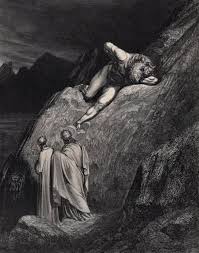
In Dante’s Inferno, specifically within Canto XII, the Minotaur stands as the terrifying guardian of the Seventh Circle, a fitting embodiment of the animalistic and irrational rage characteristic of the violent. Dante and Virgil encounter this hybrid creature—described as "the infamy of Crete" (l'infamia di Creti)—upon a broken, treacherous slope formed by the earthquake that occurred during Christ’s harrowing of hell. The monster’s presence serves as the gateway to the first ring of the circle of violence, specifically guarding the river Phlegethon, where tyrants and murderers are punished for their sins against their neighbors.
The Minotaur is depicted not just as a guardian, but as a symbolic representation of uncontrollable rage and the loss of human reason. As the offspring of an unnatural union between Queen Pasiphaë and a bull, the creature represents a perversion of nature. Upon seeing Dante and Virgil, the Minotaur reacts with frenzied, self-destructive violence, biting itself in a rage that reflects the "hot rage" the sinners it guards once unleashed on others. Virgil, demonstrating his knowledge of pagan mythology and his skill in navigating the underworld, taunts the beast by reminding it of its slayer, Theseus, causing it to thrash wildly and allowing the travelers to pass safely.
Dante’s choice of the Minotaur highlights the theme of bestial violence, where the perpetrator has lost all sense of humanity and surrendered to irrational desire. The beastly, chaotic energy of the Minotaur serves as a prelude to the violent sinners submerged in the boiling blood of the Phlegethon, who are similarly frozen in their moments of murderous fury. By placing this monster at the entrance of the Seventh Circle, Dante underlines that such violence is a perversion that merges human capacity for thought with primal, uncontrollable instinct.