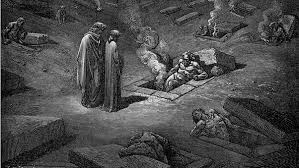
The punishment of heretics serves as a profound commentary on the dangers of intellectual arrogance and the rejection of orthodox doctrine. Located within the fiery, walled City of Dis, this circle holds those who pursued beliefs contrary to the established teachings of the Church, most notably the Epicureans who denied the immortality of the soul. Dante portrays heresy not merely as a mistaken belief, but as a willful, prideful, and active subversion of God’s truth, making it a "sin of the intellect" that separates it from the sins of lust or greed.
The punishment for heretics is highly symbolic, designed to mirror their earthly actions: they are trapped for eternity in open, burning tombs, surrounded by intense fire. Because these souls preached that the soul dies with the body, they are fittingly entombed in their own, fiery coffins, doomed to feel the pain of a "second death" in the very way they believed life ended. After the Last Judgment, these tombs will be sealed forever, locking them in a final, agonizing state of non-existence that reflects their denial of the afterlife.
A central figure in this circle is Farinata degli Uberti, a prominent Ghibelline leader and political opponent of Dante’s, whom Dante encountered standing upright in a flaming tomb. Farinata’s presence highlights the intersection of religious heresy and political factionalism in 13th-century Italy, suggesting that, for Dante, tearing apart the community of the faithful through partisan politics was a form of heresy itself. Another notable figure, Cavalcante de' Cavalcanti, emphasizes the suffering of the heretics by demonstrating that, although they can see the future, they are completely blinded to the present, a state that underscores their inability to perceive true, divine reality.
The atmosphere of the Sixth Circle is one of overwhelming heat, stench, and despair, marked by the presence of the Furies and the formidable, iron-like nature of the city of Dis. The depiction of heresy in this circle serves as a warning against intellectual pride and the willful rejection of faith, reinforcing the idea that Dante’s hell is a place of absolute justice where the punishment fits the sin.
Farinata Degli Uberti
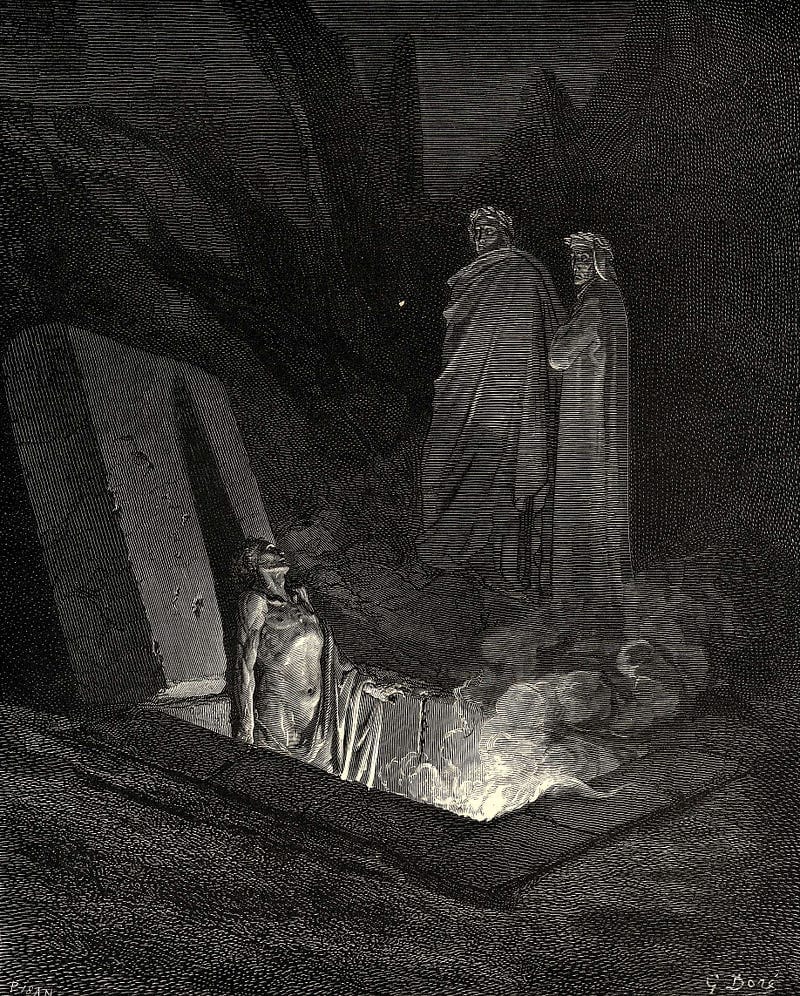
Farinata degli Uberti is one of the most imposing and complex figures encountered in Dante’s Inferno, appearing in Canto X among the heretics in the Sixth Circle of Hell. As a 13th-century Ghibelline leader who dominated Florentine politics, he is depicted as a "magnanimo" (great-souled) man who, despite being entombed in a burning grave, retains immense pride and disdain for his surroundings, rising from his fiery tomb "from the waist up" as if holding all of Hell in contempt.
Dante presents Farinata as a paradox of noble virtue and sinful pride. Though a political adversary whose family was despised by Dante's own, Farinata is portrayed with a measure of respect for his intellect and his love for his city. He is specifically remembered for saving Florence from total destruction by his own Ghibelline allies after the Battle of Montaperti in 1260, a heroic act that contrasts with his spiritual condemnation.
His presence in Hell is due to his adherence to Epicureanism, a philosophy that believed the soul dies with the body, which was considered heresy in medieval Christian theology. Consequently, his eternal punishment is to be trapped in an open, fiery coffin, surrounded by the very politics he once dominated. Farinata is one of the "Damned" who possesses the ability to foresee the future, yet he cannot see the present, a tragic irony that highlights his, and his followers', blindness to divine truth.
The encounter with Farinata is highly personal and political. He immediately recognizes Dante's Tuscan dialect and challenges him, initiating a tense dialogue about their families' opposing political fortunes. Even while suffering in the afterlife, Farinata is obsessed with earthly, Florentine politics, demonstrating that his pride and attachment to his faction (Ghibelline) continue, even in damnation.